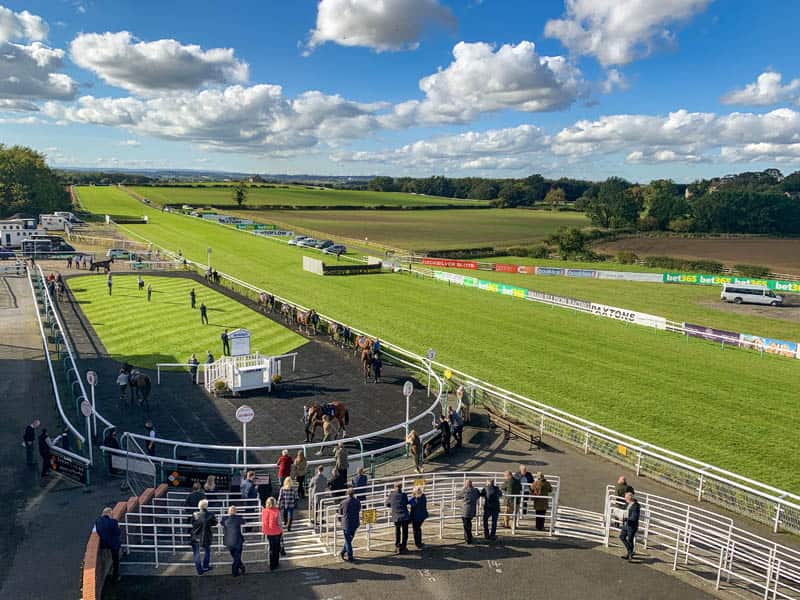
Going and Weather

GOING REPORTS & WEATHER

Going reports and weather forecasts will be available seven days prior to the fixture and will be regularly updated..

Next Fixture... Today

First Race: 01:00 PM | Last Race: 03:30 PM
Going: Available 7 days prior to the race meeting
Weather: Available 7 days prior to the race meeting
Tickets: Please call the Racecourse on 01740 621925

Racing & the Weather:

The weather is probably the single most important factor as to whether a horse meeting goes ahead or not. Weeks, days, and even hours before, owners, jockeys, and course clerks are keeping an eye on the forecast and the ground to see whether the race will carry on, and which horses will run in it.

Calling off a race

Even in bad weather conditions, including snow or pouring rain, races can still go ahead. With the exception of fog, the general concept is to look at the effect on the ground, and how dangerous this could be for the horses and jockeys.

The two main factors which will cancel a race are fog and frost. As the jockey goes over a jump he must be able to see the next fence in front. If the fog is too thick for that, the race will be called off. Likewise if there is too much frost, which doesn't look like it will clear, the course will be deemed too dangerous for the horses and riders.

Occasionally elements such as wind and sun can have an impact on horse racing as well. Strong winds during a jump race could be dangerous for the riders. As they go to jump a fence the winds could push the horses off balance, and the results could be pretty horrendous. Equally, the angle of the sun could affect the riders and their horses. If it's so severe that it will shine right into their eyes and they won't be able to see, it could be necessary to omit a fence from the course.

Planning ahead

An owner will start to plan where they want their horses to run months ahead, especially when preparing for the big events. For the majority of races though, preparations are made about two to three weeks before an event.

About a week before the race the course officials give the current conditions of the course and the forecast for the days running up to it. A couple of days afterwards, the official entries are put in by owners. From this point onwards they will be in touch with the clerk of the course for the exact details of the ground and information about the weather they are likely to face on race day.

Race day

When the day of the race arrives, the clerk is kept busy ensuring the ground is suitable for the race to go ahead with the best conditions. They measure the amount of water in the ground, either with a penatrometer (which takes a scientific measurement of the overall course conditions), or in the old fashioned way of inserting a stick into the ground, and seeing how soft the ground is. If there's been a lot of water on the course it can be very difficult to soak up immediately prior to the event. If the opposite is the case, and the ground is particularly hard, decisions need to be made as to whether to water the course, how much water to add.

The Stewards would also be on hand, and it is there job to make the final decision as to whether the race can be run. They use their personal judgement of the conditions they see, to decide whether it is safe for the race to be run.

Ideal conditions

Different courses present different conditions, and different weather affects the overall state of these grounds. The harder the ground, the faster the race is generally run, and the softer the ground, the slower the race would be. Clerks ideally aim for something between these conditions - called good to firm in racing terms. This would enable a fairly fast race, but the state of the course would mean the safety of the jockeys and horses wouldn't be compromised.

Equipment

The only things the riders really do in particular weather conditions to protect themselves from the weather, would be to wear waterproof clothing and gloves - to keep out the rain and cold. They also wear goggles to keep the splash out of their eyes. However, if it's quite wet, or there's a lot of mud being splashed from horses in front, the goggles may be worthless as they get covered in dirt.

All-weather courses

Horse owners often train their horses on all-weather surfaces, so the weather can't affect their training programme. Three out of the 59 courses in England are created like this. There have been calls for more courses to be like this so the weather won't stop events going ahead, however most owners and riders say this would make racing a lot more boring because all the courses would be the same. In the USA a lot of their courses are of this nature, but the class of racing is somewhat lower.

For more information see www.bbc.co.uk/weather


NEXT RACEDAYS

Details TODAY


Details Tue, Jan 20, 2009


> MORE RACEDAYS...

NEXT EVENTS

Details Sat, Apr 18, 2009

Miss Durham 2009 Final

> MORE EVENTS...

GETTING HERE

Whether you are traveling by car, rail, bus or air. Click here for directions >